
Category Archives: All UkulelePlay! Blog Posts
Introducing #TwoChordTuesday with the Launch of “Two Chord Camp Songs for Ukulele” Tutorials
Starting today, and each Tuesday (until I run out of material), I’ll be posting TWO new two-chord song tutorials each week. To begin with, over the next 15 weeks I’ll be sharing tutorials for each of the songs in my book “Two Chord Camp Songs for Ukulele.” Today I’ll also be sharing a bonus introductory video aimed at absolute beginners that covers how to make the chords and other ukulele basics.
Introduction
I’m currently producing content for #TwoChordTuesday, #SundaySongbook, and have other projects in the works for #MusicMonday, #WisdomWednesday, #ThrowbackThursday, #FridayFunday, and #SongwritingSaturday. Please consider joining me over at Patreon.com/Uke and supporting these projects. Patrons get access to PDFs for each of the videos I release.
A Ram Sam Sam
An Austrian Went Yodeling
Felt Ukulele & Crab Plushies
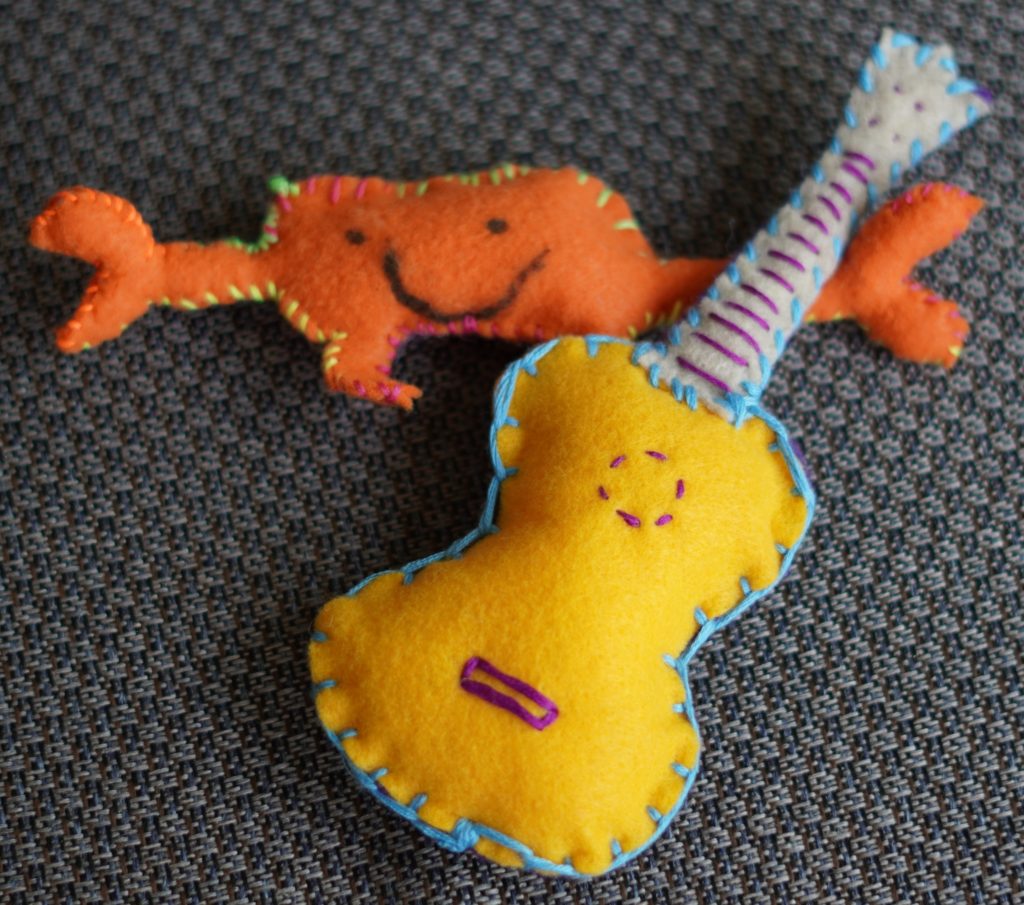
Today my family was making some plushies to give away … Taavi, my six-year-old son, designed a crab that my wife Dixie blew up into a pattern and they both worked on to stitch together. I, of course, made a ukulele. Taavi fell in love with it and took it for a pillow for one of his favorite stuffed animals, so I guess it won’t be traveling anywhere like I’d planned. The crab is still going to one of Taavi’s favorite friends.
Virtual Utah Uke Fest – Call for Entries & Open Mic Submissions
The 9th Annual Original Utah Uke Fest on June 20th, 2020 will be held VIRTUALLY, due to circumstances on a global and local level beyond our control.
What will our virtual festival look like?
- The festival will be prerecorded and uploaded to YouTube as a premiere, so people can watch and make comments in real-time as the video progresses. People will also be able to watch a replay at their convenience.
What will the segments be?
- Classes on any topic related to the ukulele. These could include obscure topics like nail care for ukulele playing, how to make a ukulele strap or case, or more mainstream topics like how to play a song, or how to do a particular strum.
- Open mic entries and performances.
NOTE: As this is a Utah-based, community-building event, we will only accept submissions from UTAH RESIDENTS.
How can I participate as a teacher?
- Send the topic you’d like to teach as an idea to ryan@ukuleleplay.com before MONDAY, MAY 18th.
- Once you have the ‘go ahead’ – film your class using whatever you have available (phone, laptop, camera, etc.), or make an appointment to come and film at Ryan’s home studio if you don’t have anything to record with on your own.
- Upload your video to a file sharing service (Dropbox, Google Drive, etc.) and send a download link to ryan@ukuleleplay.com by June 1st.
How can I submit a performance for the open mic?
- Upload a video of your performance (online collaborations, family numbers, quarantine duets/trios, etc. encouraged) to a file sharing service (Dropbox, Google Drive, etc.) and send a download link to ryan@ukuleleplay.com by June 1st.
When will the Festival Premiere?
- The festival will premiere on YouTube on Saturday, June 20th at 10am and last as long as it ends up being.
- A link to the premiere will be shared on UtahUkeFest.org as well as the festival Facebook page and through our email list (email ryan@ukuleleplay.com if you want to be on the email list).
How to Ruin Your Multi-Track Video (Epic Fail)
I’ve been wanting to make one of those multi-track videos for some time, but have been a bit nervous about the process, video-editing, etc.. Well, yesterday I pushed through my fears and made myself sit down to record all the parts for one of the songs I’ve been working on with one of my groups for our Back to the 80s set. I plugged my ukulele directly into the sound card (so as not to worry about other noises in the house – everyone’s home right now, all the time), set my metronome to 100 bpm, set up my video camera and started recording.
When I got to the video editing, I found I was having trouble getting the tracks to sync … I’d coordinate the first beat of a section, but then the music would drift apart, as if I were playing at two slightly different tempos. I thought to myself, “Is my timing really that bad?” It wasn’t until I was trying to sync up the last of the videos, a considerably longer one, that I finally clued into what was happening. The beginning was perfectly synced, but a minute later, the track was almost half a beat off. I WAS PLAYING AT SLIGHTLY DIFFERENT TEMPOS BECAUSE …
I had chosen to use my favorite WIND-UP metronome! As the metronome wound down, the tempo gradually got just a minuscule amount slower. For practice, this would not really matter so much, but for syncing digital content it spelled disaster. How much time was wasted in this effort? About 6 hours! Sigh.
Moral of the story: Next time I’ll try using a digital metronome or click track in my recording software.
Don’t Lift a Finger : Chord Voicings in the Key of F
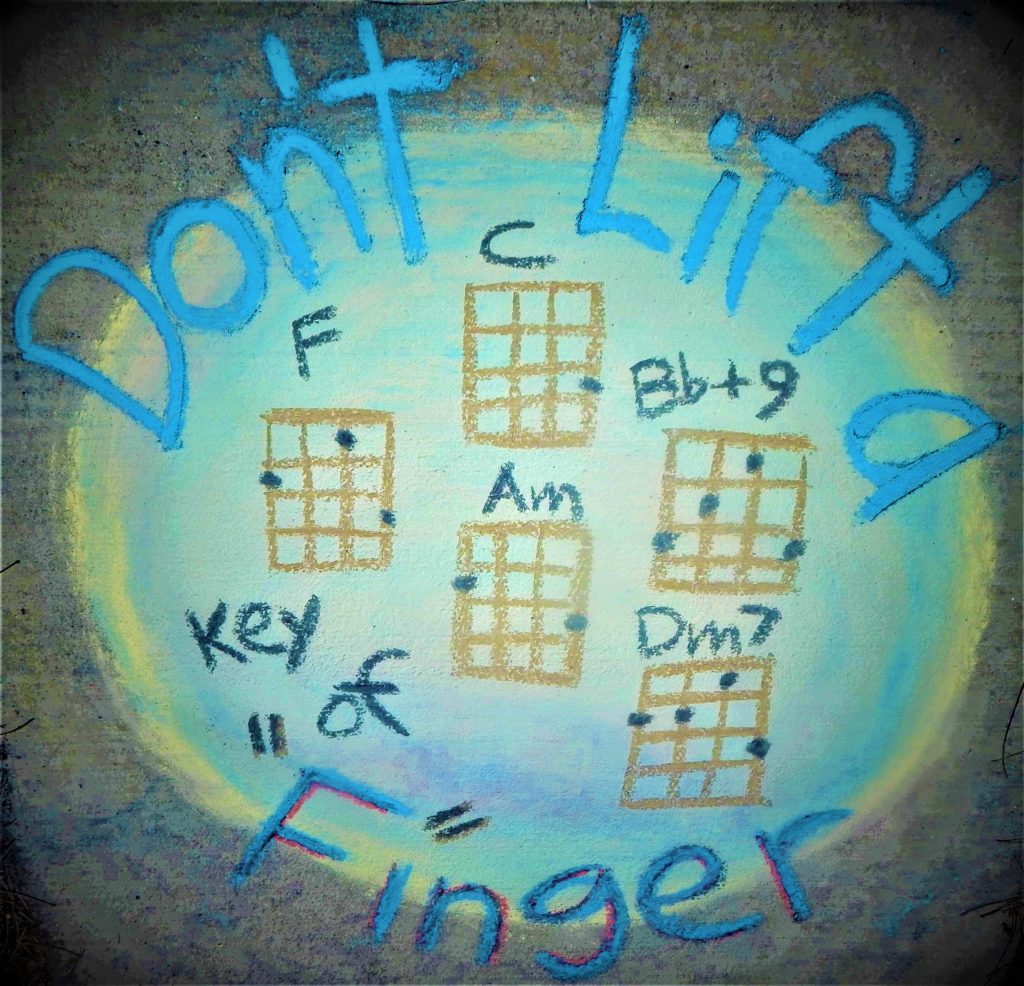
The “Don’t Lift a Finger Set” of chords for ukulele, featuring F, Bb+9, C, Am & Dm7 … the pinky-finger stays on the 3rd fret of the 1st string for all these chords. I was first introduced to three of these chord voicings in an article by James Hill in Ukulele Magazine some years ago. Later, I realized you could easily add Am & Dm7 to the list. What’s cool about this set is that it will work well for many songs in the Key of F without having to use the root fingering for Bb, which barres right next to the nut, making it a frustration for new players and tiresome (depending on your ukulele’s action setup) for seasoned players as well. Once you get used to the transitions, the don’t-lift-a-finger set makes for really quick chord changes in a key a lot of players avoid, even though it’s a GREAT key to sing in.
Ukulele Questions: How do you deal with really sore finger tips?
I was recently asked this question on social media in response to my new video on avoiding chord overwhelm. It’s one that I’ve heard many times before.
Sore fingertips is a problem that faces all players at one point or another. I don’t get sore fingertips anymore (unless I’m playing for 3-4 hours straight) because the calluses on my fingertips are so thick I can poke them with a pin and barely feel it. Calluses do build up over time if you play daily, even just a 10-15 minutes a day. The body is really good at repairing itself, so only daily practice will build the calluses.
I wish there was another solution, one that doesn’t involve building up pads on your fingertips, but as far as I know, that is just what it takes …
HOWEVER, If you’re desperate on this issue, you might consider trying one of the many marketed products that address it, but reviews are mixed on fingertip protectors and there will definitely be some trade offs for wearing silicone fingertip protectors or some kind of guitarist glove … For some people facing issues of neuropathy, or other medical issues, these may be the only way to keep playing. At least they’re worth a try. :-/
Top 5 Tips to Avoid Chord Overwhelm
Top 5 Tips to Avoid Chord Overwhelm …
Chords, chords, chords, chords, chords! The wide world of musical chords can be an overwhelming place. The way people generally learn chords, and how to use them, is often haphazard because the subject is just so vast. Here are my top five tips for diving right in and avoiding being overwhelmed by your study of chords. Let’s get going!
Tip #1 Don’t Assume You Have to Understand Chords Before You Can Use Them or that You Need a Lot of Chords to Make Music … You don’t have to understand how to build a car to enjoy driving, and you don’t have to understand what C7sus4add9 means to be able to enjoy playing it. It’s been famously said that all you need to make music is “three chords and the truth.” There are millions of songs that fit that description out there and I’ve personally collected a large number of folk, camp, Christmas and children’s tunes for my students that can be played with just two chords each.
Tip #2 Just Because a Chord has a Long, Complicated-Looking Name Does NOT Mean it is Hard to Play … On the ukulele, the Fadd9 chord only requires one finger to play, whereas a standard F chord requires two. The C, C7 and Cmaj7 chords each require just one finger to fret. Another one-finger chord with an intimidating name is Gm7b5 which I’ve often used to teach beginners to play Amazing Grace on their very first day. Don’t let the ‘taxonomic nomenclature’ of chords intimidate you. Dive in.
Tip #3 Be Reassured by Your Limits (You Only Have So Many Fingers) … On fretted instruments, you’re generally going to be using just 4-fingers to fret with, while your other hand’s fingers are busy plucking or strumming the strings. While keyboard players can use all ten fingers to play a chord, usually the right hand shoulders the bulk of the chord work, while the left plays supporting bass lines. Knowing your body and your instrument’s limits can actually be reassuring. On a ukulele, mandolin, tenor guitar, etc., you’re never going to be playing more than 4-notes at a time and that number only goes up to 6-notes on a guitar.
Tip #4 Focus on the Songs You Want to Learn … Surely there are songs out there that you love and adore. Make a short list of some songs that you’re really excited about, choose one of these and use the love you have for that song to motivate you to learn the chords you need to sing and play it. If your music doesn’t include chord diagrams, the internet has many sites where you can look up chords. I’ll post some links in the description. One of the best ways to build up your chord vocabulary is one song at a time.
Tip #5 Be Patient with Difficult Chords and Practice Them in Pairs … I’ve observed that the tendency of most players when tackling a new chord is to give it a minute or two and then immediately try to stick it into the context of a song they are trying to learn. This is stressful and unproductive. Isolate that new chord and make sure you can finger it correctly. Once you feel comfortable with the fingering, identify the chord that comes before it in the song and then put those two chords together in a loop, practicing the transition over and over until it becomes smooth … so automatic that you no longer have to think about it. Next, loop the new chord with the chord that comes after it in the song in the same way. By practicing chords in pairs like this, you’re hard-wiring the transitions into your motor memory so you won’t have to worry about it when it comes up in the song. If you give this enough time (while you’re listening to your favorite podcast, or watching your favorite show), you’ll find your transition is much smoother when you put the chord back into the context of the song. Trust me on this one; you’ll be surprised at how effective practicing chords in pairs can be.
_______
If you found this useful, don’t forget to like and subscribe. The best way to get updates on new tips, tutorials and free sheet music is to join me at patreon.com/uke
Don’t forget to comment if you have tips for others that have helped you with chords … you never know who might be helped by hearing about your experience.
Part 2 of this video series on chords will dive into demystifying how chords are built and how to explore the sea of chords without drowning.
Question on Fingerpicking for Ukulele Chords with Doubled Notes
A question from one of my local ukulele friends:
I am teaching my grand-kids ukulele. I taught them the arpeggios – adding a C on chords, such as F. They wanted to play Hallelujah and we played it. Easy enough but I was thinking that plucking the arpeggios would be nice. How do you suggest making Em chords work as an arpeggio?
Anytime you have a note that is doubled in the same octave on an ukulele chord, you can use one of the variations of what some call ‘3-string technique’ … essentially, you just pretend you only have 3-strings for a while and experiment with fingerpicking patterns. A few of the almost limitless possibilities for Em in 4/4 include:
32132132
12 3 12 3 12 3 12 3 (where the twelves are a double-stop)
12312312
43134313 or 23132313 (identical)
You sort of just have to play with it until you find what you’re looking for. Hope that helps!
Kingsfold (If You Could Hie to Kolob) : Ukulele Tablature Solo
Free TAB available at https://www.facebook.com/groups/77615… in the files section. Support this project at http://patreon.com/uke and find more ukulele songs, materials, tutorials, reviews and tabs at http://ukuleleplay.com
That Easter Morn : Ukulele Tablature Solo
Free TAB available at https://www.facebook.com/groups/77615… in the files section. Support this project at http://patreon.com/uke and find more ukulele songs, materials, tutorials, reviews and tabs at http://ukuleleplay.com
Jesus Once Was a Little Child (Ukulele Tablature Solo)
Free TAB available at https://www.facebook.com/groups/77615… in the files section. Support this project at http://patreon.com/uke and find more ukulele songs, materials, tutorials, reviews and tabs at http://ukuleleplay.com
Jesus Wants Me for a Sunbeam *Calypso* Ukulele Sing & Play Along with Tutorial
Tutorial at https://youtu.be/jJfhsYmOAVA … Free TAB available at https://www.facebook.com/groups/77615… in the files section.
Gerald Ross : Ukulele Players You Should Know
Gerald Ross consistently puts out great renditions of swing time anthems on his youtube channel. He’s a great player and teaches at a number of festivals throughout the year. His latest is a song from 1926, Sunday:
If you’re interested in swinging your uke like Gerald, he has a popular series of Beginning Swing Ukulele videos:
And in closing, another wonderful swing cover, Sweet Georgia Brown:
Over the Rainbow Instrumental Video Tutorials
I created these Over the Rainbow tutorials for my Ukulele Youth Choir students, but thought others might be interested as well. The music is visible in the video, but if you’d like to print a copy you can purchase this arrangement on Sheet Music Plus. There are five videos …
- Tutorial on the Chords (intermediate level chords).
- Play-through of the chords to practice with.
- Tutorial for for Ukulele 2 Tablature (Part 1).
- Tutorial for for Ukulele 2 Tablature (Part 2).
- Tutorial for Ukulele 1 Tablature (Melody part).
You can watch them below or with these links on YouTube: https://www.youtube.com/playlist?list=PLa626nR993Oy6wzx3QSc-_kfYhpBzD1o2 or https://www.youtube.com/watch?v=WqdByWx-ODw&list=PLa626nR993Oy6wzx3QSc-_kfYhpBzD1o2
Amazing Grace : Simple Chord Melody (PDF)
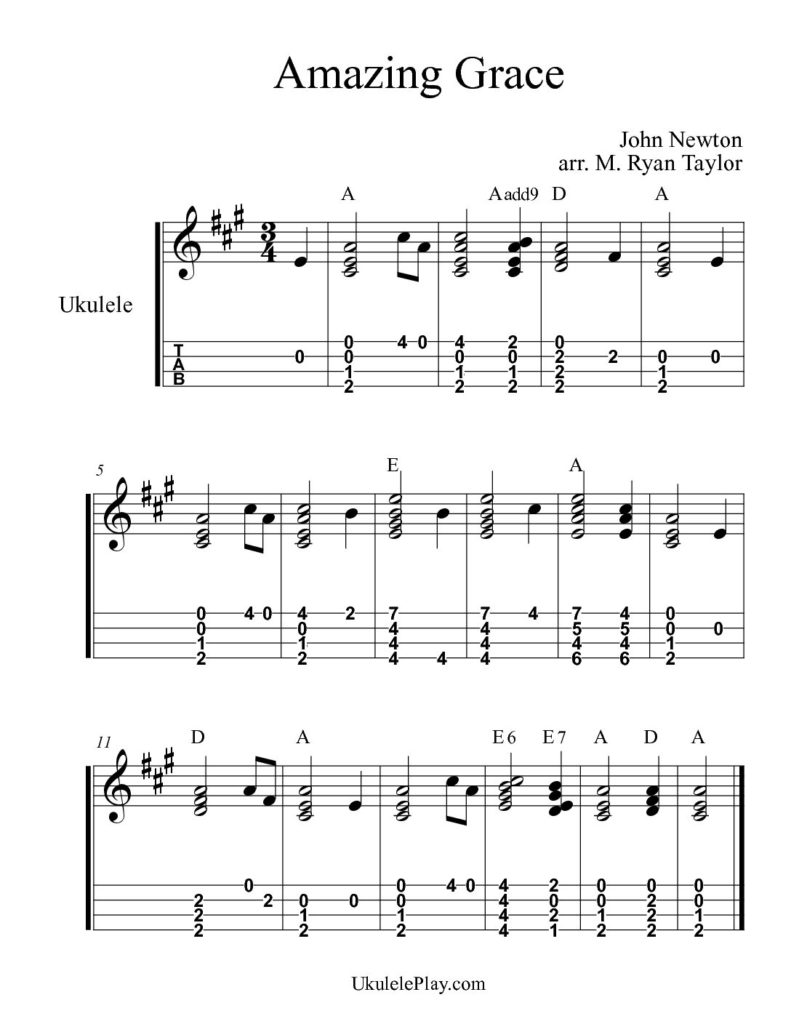
If you’re interested in the process of writing a simple chord melody arrangement like this, see http://ukuleleplay.com/how-to-make-a-simple-chord-melody-for-ukulele-amazing-grace/
Letter from Slovenia (Choosing Chords for a Melody)
I saw you on facebook and i need some help. How can i turn sheet music for piano to ukulele chords? I would like to play Slovenian children songs, but i only have the sheet music for piano. Can you help me?
Changing piano to ukulele chords requires a bit of knowledge of how chords are built. You’ll have to identify the chords in the piano part, by looking at the notes that are being played together and then look up those chords using something like https://ukebuddy.com/ukulele-chords
Alternatively, you can identify the key of the song, isolate the melody and then just experiment with the chords in that key to see which ones sound good to you. For example, in the key of C, the most common chords are C, Dm, Em, F, G, Am, & G7. In essence, you’re ignoring the piano part and creating your own arrangement.
I sent you one photo of a Slovenian song and my way to convert piano notes into chord. First i wrote down tonality, so this song is in C. And there are three main grade: T, S, D. And on T there is C chord, on S there is F chord and on D there is G chord. So i play this song on ukulele with this three chords: c, f and g. And for every beat, i chose one of this chord. Or i just play the first note in the beat? So in the first beat there is g, so i play G chord, in the second beat there is a, so i just play A chord and so on.
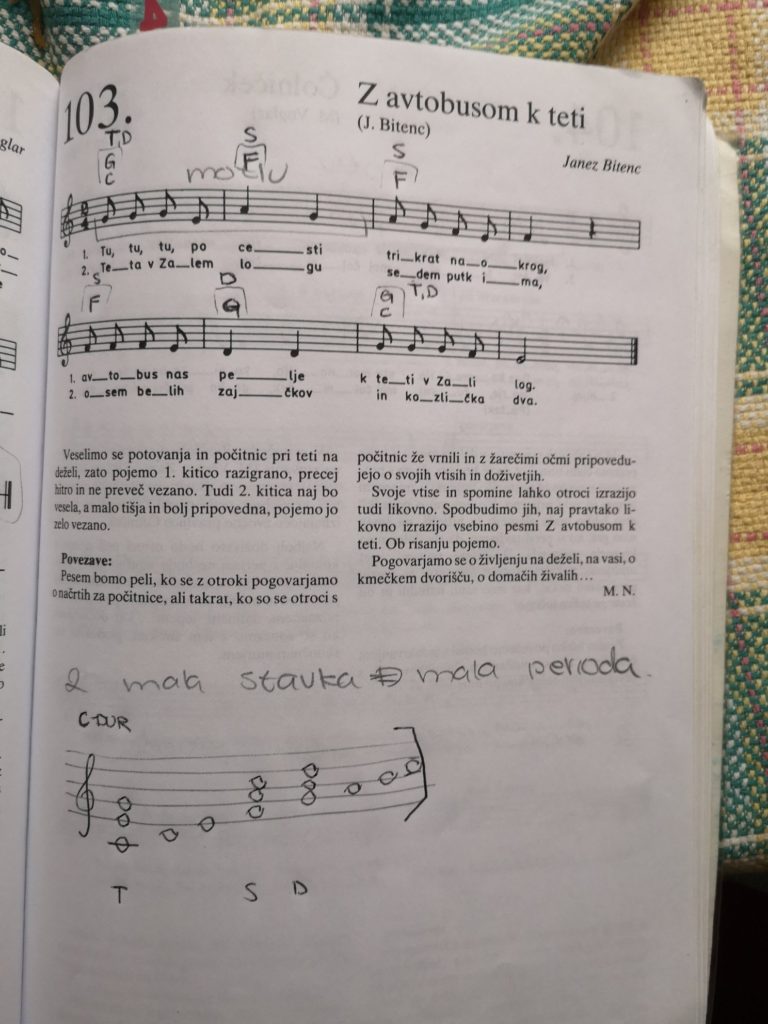
This is looking quite good. There a so many ways to harmonize a simple melody like this. One of the many possibilities that I might do with my students on this melody might be (each chord = a quarter note):
C C Am Am F F Dm Dm
F F G7 G7 C G7 C
You could also use G instead of G7 if you like that better. I’ve attached a chord chart that shows how to make all the above chords.

How to Make a Simple Chord Melody for Ukulele (Amazing Grace)
A simple method for creating a basic chord melody arrangement of Amazing Grace (though the principles apply to any melody). Walk through the steps from start to finish, including tips on selecting your key, chords and editing your tablature. Though I use Finale in the tutorial, paper and pencil or the free notation program MuseScore will work just as well. Hope you find it useful and get inspired to start your own arranging projects for tunes you love.
Ukulele Orchestra of Great Britain : Ukulele Players You Should Know
As far as I know, the Ukulele Orchestra of Great Britain (UOGB) is one of two main prototypes for ukulele orchestras/bands/ensembles in the world (the other being created by renowned ukulele educator J. Chalmers Doane in the Canadian educational system, under which James Hill received his initial training). The UOGB combines ukuleles, awesome musicianship, mediocre (voice of the people) singing, in amazing arrangements filled with humor and British deadpan. I was lucky enough to see them when they were on a world tour and happened to come to Kingsbury Hall in Salt Lake City (they were great). If you can’t go see them live, which is everyone at this moment of self-isolation, I have good news, especially since they’re not regular video posters, that they just released Ukulele Lockdown. Episode 1, Clip 1 : Higher and Higher.
While we wait for the next clip, enjoy some popular UOGB performances, beginning with the one that gives me chills (in a good way), ‘Medley’. I show this one to all my new students at my Ukulele Bootcamps:
Check out more from the UOGB at https://www.youtube.com/results?search_query=ukulele+orchestra+of+great+britain. Thanks UOGB for your decades of awesomeness. You are an inspiration to me!
I “C” Uke in Your Future : Chalk Walk Art Chord Chart for the Key of C
Our neighborhood had a chalk walk today. This was one of my entries, a basic chord chart for the Key of C. 🙂
Pirate Ukulele (Just for Fun)
A pirate ukulele made by Ukulele MOTU : this thing is awesome. I love that its based on a Tahitian ukulele design with the sound hole in the back.
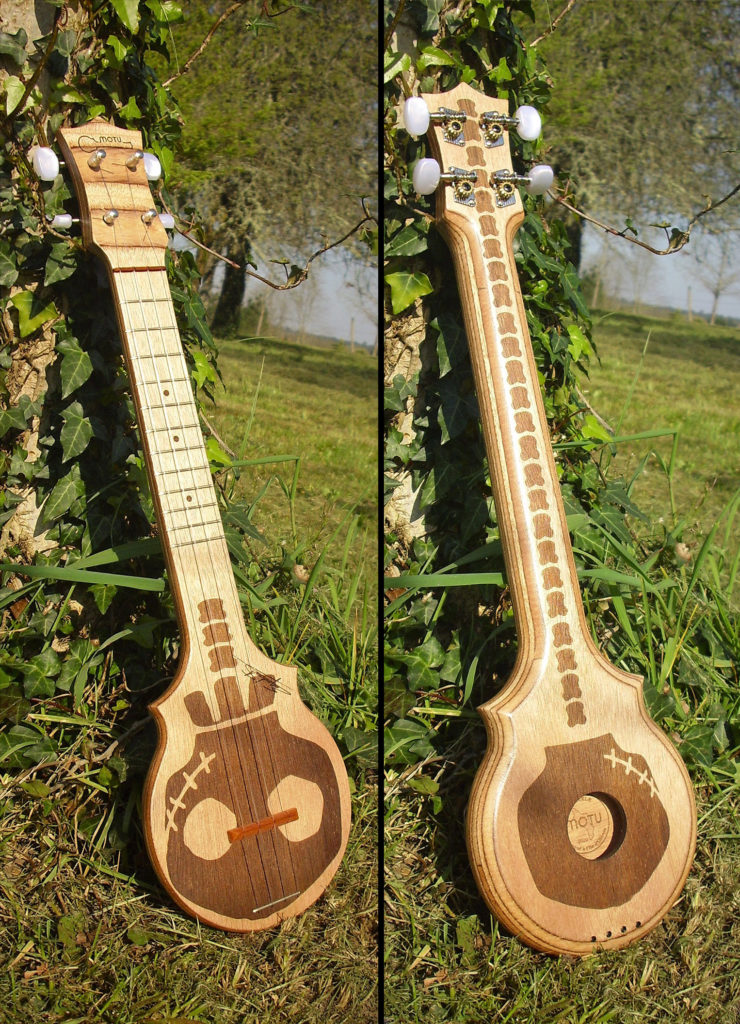
Photo by u/CocoCapitainePoulet (reddit) – Used by permission.
Piano to Ukulele Chords

A question I got today:
I saw you on facebook and I need some help. How can I turn sheet music for piano to ukulele chords? I would like to play Slovenian children’s songs, but i only have the sheet music for piano. Can you help me?
Changing piano to ukulele chords requires a bit of knowledge of how chords are built. You’ll have to identify the chords in the piano part, by looking at the notes that are being played together and then look up those chords using something like https://ukebuddy.com/ukulele-chords
Alternatively, you can identify the key of the song, isolate the melody and then just experiment with the chords in that key to see which ones sound good to you. For example, in the key of C, the most common chords are C, Dm, Em, F, G, Am, & G7. In essence, you’re ignoring the piano part and creating your own arrangement.
I plan to create some videos soon about these topics in more detail. Please let me know if you’d like me to add you to my announcement list so you can hear when they come out (ryan@ukuleleplay.com).
Danielle Ate the Sandwich : Ukulele Players You Should Know
Shifting focus on this series from great instrumentalists to great singers that happen to play the ukulele as their main instrument. Up first, Danielle At the Sandwich. I first saw Danielle perform live at the Denver Uke Fest. I’ve since had the opportunity to meet her in person and she’s got just as lovely of a personality as she has a lovely voice. She just released this new video today (which put her fresh in my mind):
I think she’s a fantastic songwriter … In fact she’s written one of my all-time favorite songs ever, Peace to You Brother:
Lest you think she can only do dreamy music … she’s also a great cover artist:
Thanks Danielle being awesome! 🙂