
Category Archives: All UkulelePlay! Blog Posts
Beyond D DU UDU : Favorite ‘Go-To’ Strums from 5 Ukulele Bloggers
Everyone seems to know the unofficial international ukulele strum, D DU UDU, but there is so much more you can do with the right hand. 5 ukulele bloggers weigh-in on their favorite ‘go to’ strums . . .
Modified Clawhammer Strum
One of my favorite strums goes like this:
- Thumb plucks “c” string.
- Down strum all four strings.
- Index finger pluck “a” string.
- Thumb plucks “g” string.
- Down strum all four strings.
A variation of this pattern (and a song tutorial) can be found here:
http://circuitsandstrings.wordpress.com/2013/01/18/lafayette-lilt-tutorial/
~Daniel Hulbert of circuitsandstrings.wordpress.com
Daniel will be teaching at this years Utah Uke Fest.
SKA Patterns
This video will (hopefully) supply you the foundation you need to start jamming with some ska tunes.
Before I had a family and a real job, I spent my days touring with a couple different ska bands. For some reason this genre of music, with it’s happy upbeats and carefree attitude has always appealed to me and the style transfers quite well to the ukulele. I guess that it makes sense…the ukulele originates from a sunny island (Hawaii) and ska music comes from a similar, albeit different island (Jamaica).
This style of music is all about timing – your strumming hand and fretting hand really have to be in sync and know what each other is doing. Like riding a bicycle, it might be frustrating and seem impossible at first, but with enough patience it will eventually click.
~Miles Ramsay of UKEonomics.com
The ‘Easy’ Split Stroke
This video demonstrates a simplified version of the split stroke with the song, The Old Ark’s a Moverin’ that I teach in my Level 2 ukulele classes:
This ‘easier’ version of Split Stroke splits 2 ‘triplet strums’ and a down-up evenly across 4 beats to create a syncopated, driving foundation for singing. Here’s two ways to look at it:
- Dt uD tu Du
- Dtu Dtu Du
D = accented down strum with the index finger
t = strumming down with the fleshy part of the thumb
u = up strum with the fleshy part of the index finger
If you’re just getting started with split/syncopated rhythms, take it slowly at first and work your speed up little by little.
~M. Ryan Taylor of UkulelePlay.com
Bossa Nova Strumming
Chords:

Tuning: G C E A ( high G ), Beat: 4/4, Tempo: 118 bpm
Strumming Pattern:
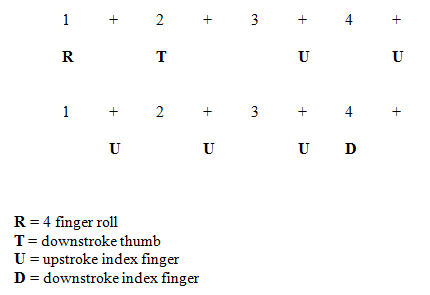
This is one way to play Bossa Nova style on your ukulele:
- First learn the strumming pattern ( 2 bars long ).
- In the beginning mute the strings with the left hand as shown in the the video.
- Mind the change from downbeat ( downstroke ) to offbeat ( upstroke ). This is called Partido Alto and brings some Latin touch in the strumming.
- Start with one chord and then add the others.
- Mute the strings between the strokes with your left hand.
~FriendlyFred of uke4u.com
Vaudeville and Variety-Style Strumming
I tend to play jazz and pop from the first four decades of the 20th Century, music that calls for strums that provide the ability to create syncopated rhythmic combinations, including triplets, 16th notes and 32nd notes.
The four strums I use most often are known as the “fan stroke”, the “triple”, the “double-time”, and the “split stroke” – as George Formby called it – or “syncopated stroke” – as Roy Smeck referred to it. All four are used liberally in this video of the 1931 tune “Lady of Spain”, which has forever been associated with the accordion.
I play the verse and refrain through twice using a combination of fingerpicking and various strokes and rolls, including flamenco-style finger rolls in refrain at 0:15, 1:15 and 1:24.
Then, at 1:32, I pick up the pace and run through the refrain using two strokes primarily: the triple and the double-time.
Let’s start with the simplest: the double-time. This is just a “down-up” every beat. It’s useful for creating a double-time feel if you increase speed and play it “down-up – down-up” every beat.
Now, the triple. This is often mistakenly referred to as a “triplet” stroke. It is and it isn’t. The triple stroke is actually a quarter-note triplet followed by an additional quarter note downstroke – “da-da-da – daa”. This is achieved by doing a downstroke across all four strings with the index, followed by a downstroke with the thumb, followed by an upstroke with the index and thumb together, followed by a downstroke with the index and thumb together – “down-down-up – down”.
I use the fan stroke several times in this arrangement. At 1:56 and again at 3:11, I play the classic triplet fan stroke. Its made up of three strokes – a downstroke with the nails of the pinky and ring finger, followed by a downstroke with the pad of the thumb, followed by an upstroke with the nail of the thumb. The effect is a straightforward “da-da-da”. You can see that I break my wrist when I do it, moving my hand in a circular fashion. On the downstroke with the pinky and ring fingers, the hand fans out – hence the name of the stroke. This stroke can be immediately and infinitely repeated, with the effect of an almost infinite triplet.
Finally – there’s the split stroke – I play a version of the refrain based on the split stroke starting at 2:28. It was the hardest of the above strokes to learn and – unfortunately – it’s the hardest for me to explain. The basic stroke is accomplished with the thumb and forefinger held together as for a basic downstroke strum. The stroke is “down-up-Down, down-up–Down, down-up” and the rhythm is two eighth notes followed by two syncopated triplets. The name “split” comes from the fact that on the initial downstoke, you only hit the botton two strings of the uke; then on the upstroke, you only this the op two strings of the uke. Then, on the third downstroke, you strike all four strings. This approach gives you the right accents. You hit the accents on the full four-string downstrokes of the figure, so the effect is “ba-da-DA, ba-da-DA, ba-da”. I learned how to play this stroke from watching videos made by fellow George Formby Society members Matt Richards http://www.youtube.com/watch?v=qhjy9_3rusc Peter C. Nixon and Mike Warren http://www.youtube.com/watch?v=t8cnPP3SU5s . I also highly recommend their tutorials of the additional Formby strokes – the Fan, the Triple, and the Shake, which I am still struggling with.
Those four strokes are “go-to” for me, with the Triple and Double being most commonly used to drive the tempo, but the fan and split stroke are often used in the way that a tenor banjo player might use a tremolo – as a means of holding a note or injecting interest in a solo or accompaniment.
~ John Bianchi of theukaholic.blogspot.com
Thanks to all the guest bloggers for sharing some awesome info!!!
You’re a Grand Old Flag : Ukulele Duet
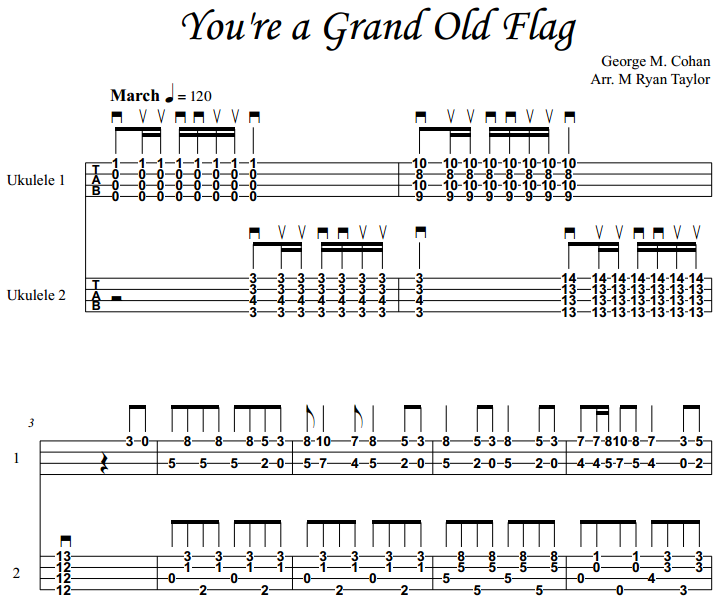
A classic piece of George M. Cohan Americana arranged for two or more ukuleles:


Enjoy!
Didn’t My Lord Deliver Daniel

One of my favorite spirituals in a variety of different versions:
- Didn’t My Lord Deliver Daniel (pdf)
- Didn’t My Lord Deliver Daniel 2-part (pdf)
- Didn’t My Lord Deliver Daniel 2-part with Descant (pdf)
- Didn’t My Lord Deliver Daniel Choir Only (pdf)
“He delivered Daniel from the lion’s den . . . then why not every man?”
Enjoy!
There is a Haunted House in Town

This parody of “There is a Tavern in the Town” is another of my Halloween favorites:
Enjoy!
Three Blind Mice

- Three Blind Mice (pdf)
The classic children’s song in two versions, regular and a special 1-finger chord arrangement with some altered melodic notes.
Enjoy!
Itsy Bitsy Spider
The classic children’s song in two versions, regular and a special 1-finger chord arrangement with some altered melodic notes.

- The Itsy Bitsy Spider (pdf)
Enjoy!
Mister Rabbit
A classic children’s folk song, just in time for Easter.

- Mister Rabbit (pdf)
There are a lot of variations on this wonderful tune; one of the most charming is Burl Ive’s rendition. Enjoy!
Blood on the Saddle
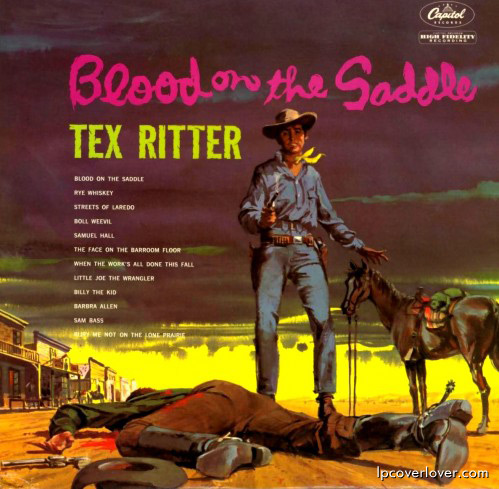 I love this parody of ‘Western’ cowboy songs (whose origin likely includes college glee clubs). It has enjoyed quite a bit of popularity with actual ‘Western’ folk artists (I recently bought a record of such, just because it had this track on it). However, the most famous recording comes from Tex Ritter.
- Blood on the Saddle (pdf)
I like to program this song around Halloween; I’m a big fan of the humorous side of the holiday, I even have my own Halloween album and website for kids.
Two by Two : Round for 4 with Ukulele Chords
 Two by Two (pdf)

An original round celebrating the Noah’s Ark story from Genesis. Provided with Ukulele, Baritone Uke & Guitar Chords.
FYI: One of the early ‘approved’ toys for children to receive at Easter time was a Noah’s Ark playset.
Another ‘Ark song,’ a spiritual, “The Old Ark’s A-Moverin’,” can be found in the 123 Ukulele Play Songbook.
Pineapple Ukulele to Resonator Rescue
-
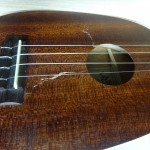
- My wife swears she didn’t sit on it! But has no explanation for how her uke came to be cracked in on the surface. Rather than complain, I took the opportunity to have a DIY project this last weekend.
-
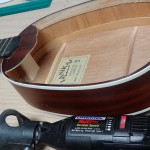
- Routed out the damaged wood on the top.
-
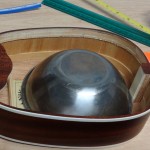
- Found a bowl we never use (a wedding gift) that fits the space.
-
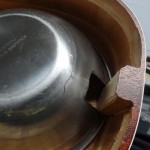
- Had to remove part of the bowl so the bridge would make it onto the flat of the bowl.
-
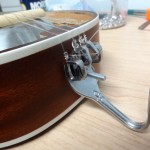
- I read somewhere that forks work great for this.
-
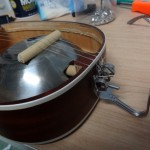
- Stringing it up.
-
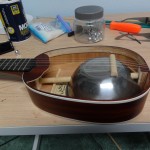
- You’ll notice I had to put a dowel through the bowl to provide support against string tension.
-
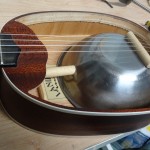
- Still debating whether I want to drill holes in the bowl.
-
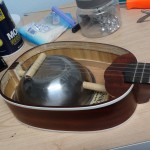
- It sounds pretty good. Like a really quiet distorted guitar.
-
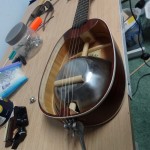
- I do wish it was a little louder, but it is once again playable. 🙂
Kingsfold : New Ukulele Tablature
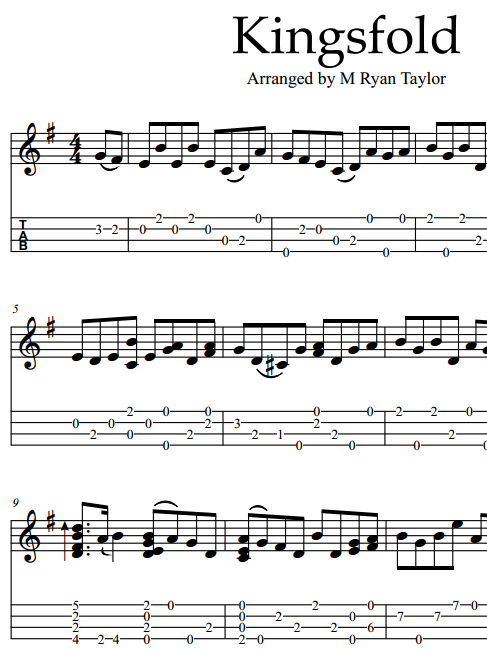
- Kingsfold PDF (Ukulele Tablature Solo)
This famous tune has been used for hymn-texts such as “If You Could Hie to Kolob,” “O Sing a Song of Bethlehem” & “I Heard the Voice of Jesus Say.”
Arranged in a mostly ‘campanella’ style, a la John King.
Two Chord Christmas Songbook now on Amazon and Sheet Music Plus!
- Amazon : http://amzn.to/VBBhSi
- Sheet Music Plus : http://www.sheetmusicplus.com/title/19839731
- eBook : http://bit.ly/PYxihv
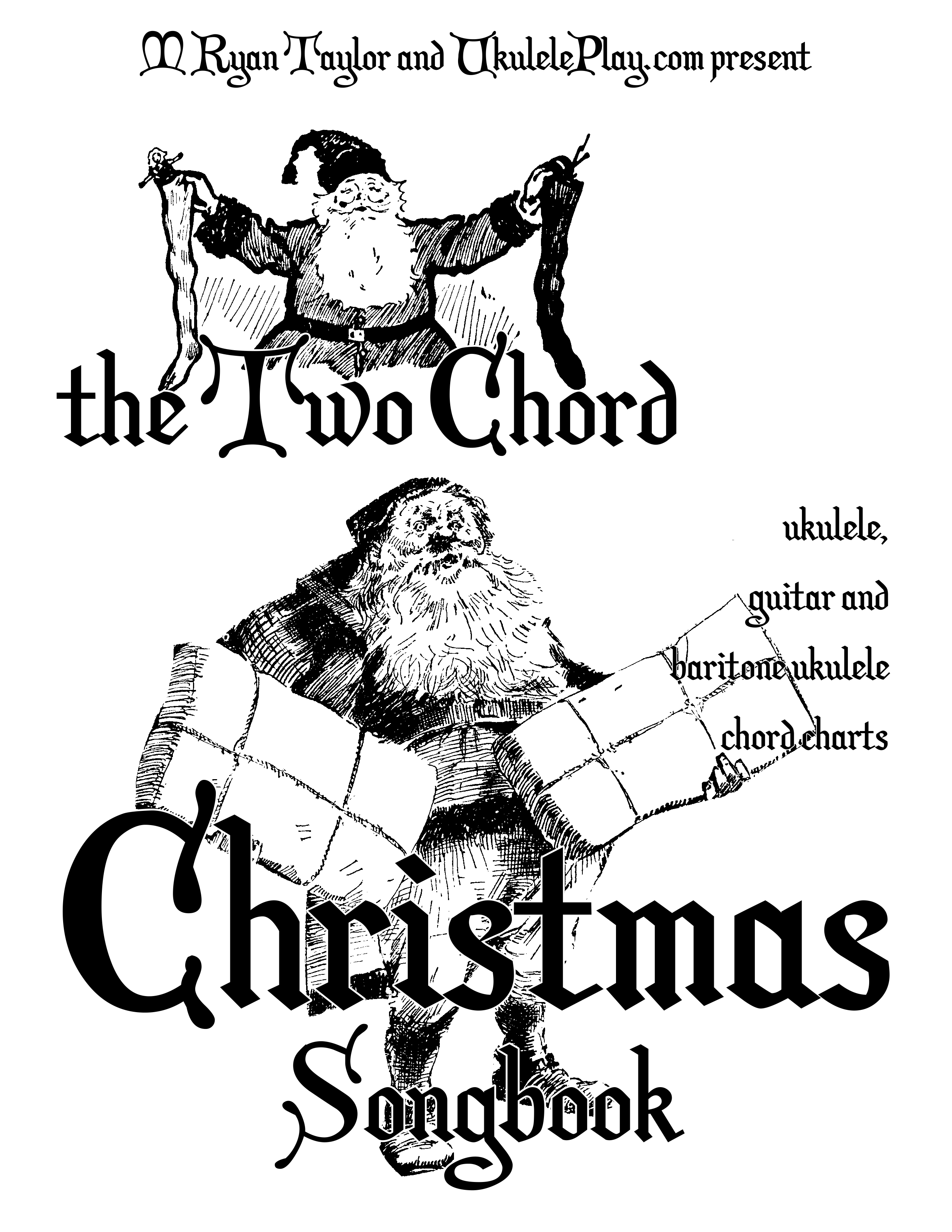 34 beautiful Christmas songs that sound great with just two chords each! Chord charts for ukulele, guitar and baritone ukulele included. These songs have been hand-picked for greatness from over a hundred possible selections (and those found amid hundreds and hundreds more). There are no ‘filler’ songs here; each stands on it’s own for solo or group singing. Many are lesser-known carols, but every one is a gem. So, whether you’re a soloist, in a small group, or the leader of a large community, you’ll find some great songs to add to your Christmas caroling repertoire.
Contents:
- Apple Tree Wassail
- As Joseph Was A-Walking
- Behold that Star
- Carol of the Bagpipers, The
- Cherry Tree Carol, The
- Child of God
- Christ Child’s Lullaby, The
- Christ Was Born on Christmas Day
- Christmas Eve is Here
- Cold is the Morning
- Come Running You Shepherds
- God Bless All
- He is Born (Il Est Ne)
- Hear Them Bells
- Hey, Ho, Nobody Home
- Huron Indian Carol
- I Saw Three Ships
- I Saw Three Ships (alternate)
- Mary Had a Baby
- O Christmas Tree
- O Leave Your Sheep
- O Little Town of Bethlehem (Forest Green)
- Pat-a-Pan
- Quickly Now, O Shepherds
- Rise Up Shepherd and Follow
- Sleep of the Infant Jesus, The
- Star in the East
- Still, Still, Still
- Tomorrow Shall Be My Dancing Day
- Truth from Above, The
- Wassail! Wassail all Over the Town!
- Welsh Carol
- What Shall We Give?
- Wondrous Love
Where is He? – Matthew 2:2 (Round for 3)
Though this round could be sung by anyone, I wrote it with 3 men in mind, representing the wise men from the east. Chords for ukulele, guitar and baritone ukulele are provided for an optional accompaniment.
Merry Christmas!
Text from Matthew 2:2
Where is he that is born King of the Jews? for we have seen his star in the east, and are come to worship him.
The Two Chord Christmas Songbook eBook released
My new Christmas songbook is now out; 34 hand-picked songs, each requiring only two chords. Charts are included for ukulele, guitar and baritone ukulele. Check it out here: The Two Chord Christmas Songbook
I’m a Giraffe

Round for 3 by M Ryan Taylor. Includes chords for ukulele and baritone ukulele.
Words:
I’m a giraffe, A giraffe am I; When I stand on my toes my nose bumps the sky.
Thirteen for Halloween : Ukulele Edition
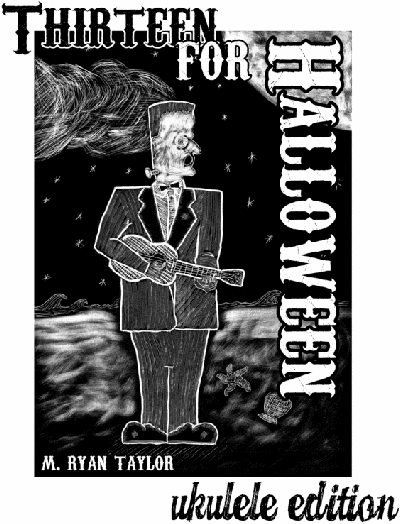 New for 2012! The long-awaited ukulele editon of Thirteen for Halloween (link goes to tradebit.com) is now available for instant download. This Halloween songbook contains ukulele chords (C tuning) AND chords for baritone ukulele.
Includes all the songs from the Thirteen for Halloween album:
- Welcome Said the Spider
- The Ghost of John
- Three Little Ghostesses
- Mactavish Is Dead
- Skin and Bones
- Queen Nefertiti (The Mummy)
- Old Witch, Old Witch
- Witch, Witch, Where do you Fly?
- Im a Mean Old Witch
- Unlikely Company
- The Ghost Ship
- Were Back!
- Five Little Pumpkins
Get the matching “Frankenstein on the Beach” ukulele t-shirt (link takes you to printfection.com)!
For more Halloween fun, visit ThirteenforHalloween.com. For more ukulele awesomeness, visit UkulelePlay.com.
March of the Spiders – Easy Ukulele Chord Solo by M Ryan Taylor
 From my ‘work in progress’
entitled The Giant’s Heart:
- March of the Spiders (PDF Tablature)
Back story: I’d been working on a new opera entitled The Giant’s Heart, but when I got to the scene about the giant spiders I knew I wanted the spiders to be represented musically by fretted string instruments, but beyond that I was stuck. I halted work on the opera and the next Winter got into the ukulele. Some time later I was messing around and thought, “That’s the march of the spiders” (when they go up the mountain to chase away the she eagle that is sitting on the giant’s heart).
Its taken me a while to get it down on paper, as I use Finale and it is not really that tablature friendly, but I’ve decided to bite the bullet and just push through the learning curve and the hurdles the program makes you go through.
Hope you enjoy!
‘O Sole Mio
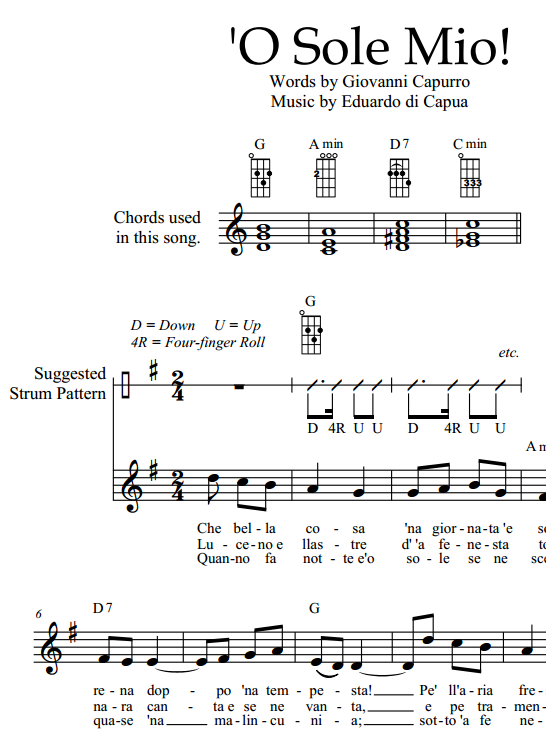 One of the most famous Italian (Neapolitan) songs of all time and sung by everyone from the Three Tenors to Elvis Presley (as It’s Now or Never):
- ‘O Sole Mio (for Voice and Ukulele)
The Stars and Stripes Forever : Ukulele Chords with Words by John Phillip Sousa (3 keys available)
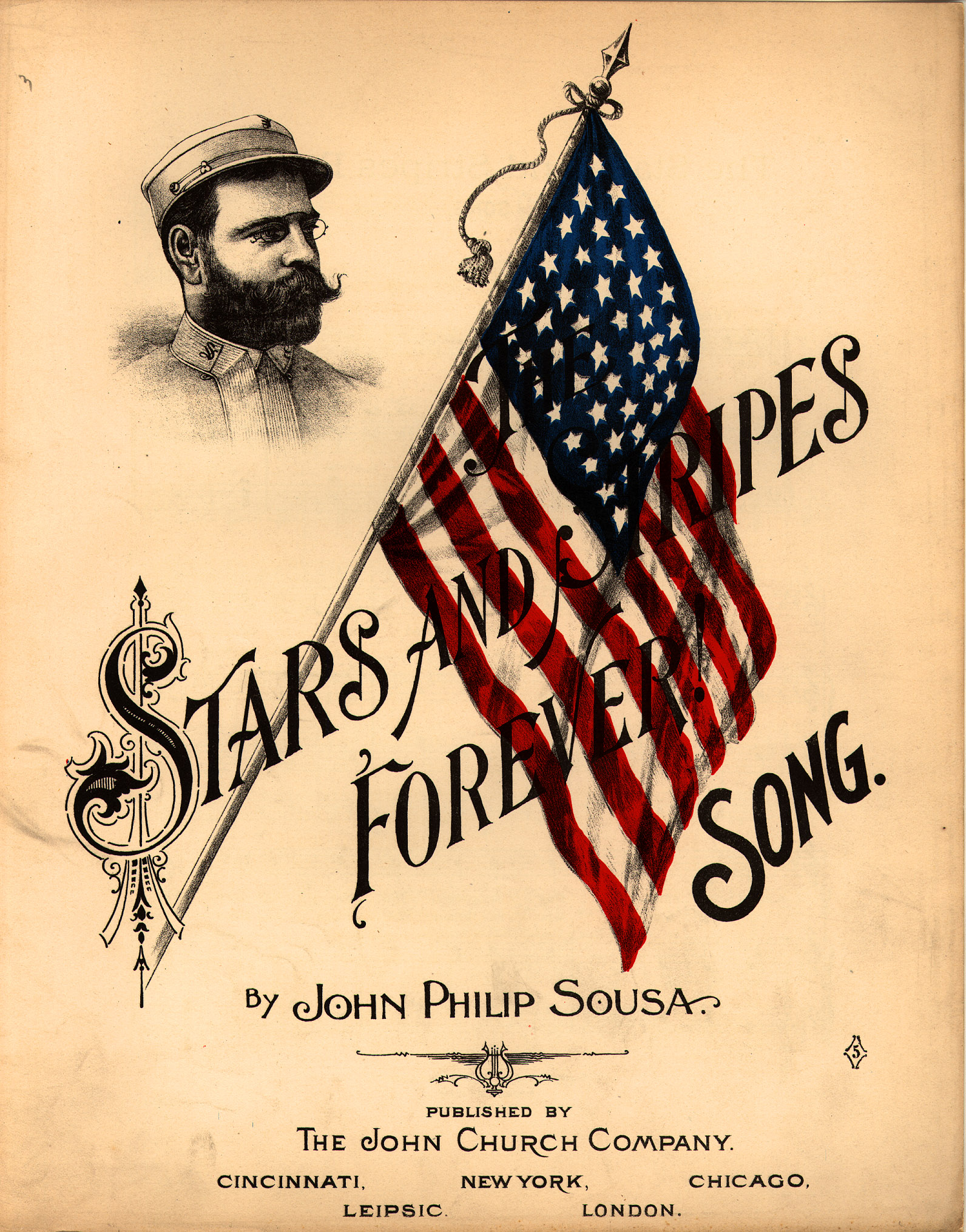
The original cover art for "the stars and stripes forever" with words penned by Sousa himself.
Here is John Phillip Sousa’s famous march, The Stars and Stripes Forever, with words he penned himself. I originally started singing this with an old recording of Sousa’s own band, but don’t always want to haul sound equipment around and I love singing it. The melody covers a two-octave range, so you do need some pipes, but if you’re ukulele is strung with a low-g, you can play the melody solo while having another player fill in on the chords.
- Stars and Stripes Forever – Eb (Original Key) : With this key you could actually sing along with a recording of the march, but I’ve always found a couple of spots high for my voice.
- Stars and Stripes Forever – D (Easier)
- Stars and Stripes Forever – C (Easiest) : Now that I’ve transposed it down, I’m loving how this key feels in my voice (I’m a baritone), and the key makes it super easy to play.
Have fun with it!
Ex amore victoria!
Ryan
We Wish You a Merry Christmas Sheet Music for Ukulele and Voice
Ukulele Ornament on Amazon
First off, the music:
I love this song and I love the fact as a teacher that it cycles you through so many useful chords in a progression that will ‘bless your life’ for use with future songs. This one page PDF of We Wish You a Merry Christmas for Ukulele (and Voice) also contains a nice-sounding fingerpicking pattern that shows off the cool chord progression of this song. Here’s a basic roadmap of the song:
- The Thumb (T) alternates between the 3rd and 4th strings while the Index and Middle fingers (I/M) work together as a unit to pluck the 1st and 2nd strings at the same time. The pattern has three beats: T on 3rd string, I/M on 1st/2nd, and T on 4th string – the pattern then repeats.
- See the score for a slight alteration of the pattern on the words “Happy New Year.”
- An alternate strum pattern is provided for the middle verses of the song. I think it’s a fun contrast to play this part really fast (it brings out the humor of this section).
- On the final chorus you return to the fingerpicking pattern.
It’s all there in the instructions on the sheet music.
This arrangement was created for the Utah Ukulele Circle which meets in American Fork on Tuesday nights. We performed it twice in 2011; Christmas in the Rotunda at American Fork Library and at Heritage Care Center a couple of days later for the old folks there.
Merry Christmas!
O Holy Night for Ukulele, Voice and optional Bass
Ukulele Angel Ornament on Amazon
First off, here is a free version of “O Holy Night” with the words, melody, and ukulele chords:
- O Holy Night – Voice & Ukulele Chords (Free Version)
A premium version of this ukulele arrangement (for advanced beginners and intermediate players) with suggested fingerpicking and strumming patterns in tab and traditional notation, as well as melody, words and chords can be downloaded through tradebit. There is also an optional bass part for duos or ukulele ensembles. A preview is available on these pages:
This arrangement was created for the Utah Ukulele Circle which meets in American Fork on Tuesday nights. We performed it twice in 2011; Christmas in the Rotunda at American Fork Library and at Heritage Care Center a couple of days later for the old folks there. I added the Bass Part for future use, as I’m also a bass player.
Merry Christmas!